![]() |
![]() |
|
|
|
|
An oceanographic research expedition to hydrothermal vent sites along the East Pacific Rise aboard the R/V Atlantis with the DSV Alvin. Check out the current location of the R/V Atlantis by clicking here.
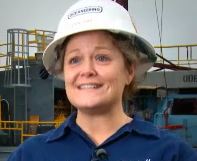
Diana Wellman, a participant in the MATE Center's Technical Internship Program, and I have the extraordinary opportunity to take part in this expedition. I'm Jill Zande, Program and Outreach Coordinator for the MATE Center. I'll be documenting this cruise, sending back reports on the day's activities as we dive with the DSV Alvin to vents sites 2,500m (8,250ft) below. Using the Alvin's camera systems, which include a High Definition (HDTV) video camera, and the IMAX camera, our dives will capture incredible images of the vent communities - 6-foot long, blood-red tubeworms, mussels, crabs, and eel-like, seemingly translucent fish to name a few organisms - which I'll be sharing with you on this site. I'll also bring back data in the form of images and biological, physical, and chemical information, that students and educators can use to develop student and class projects and to teach and learn data management, processing, and analysis techniques. As a part of the MATE Center/University-National Oceanographic Laboratory Systems (UNOLS) internship program designed to place students on board UNOLS research vessels, this expedition will offer Diana the opportunity to see and experience first-hand the technologies, such as the Alvin, that are used to support scientific research. Guided by members of the Deep Submergence Operations Group (DSOG) and the ship's crew, Diana will have tasks to complete, including equipment to ready and maintain, and problems to solve. So join us daily for reports and images. And stay tuned - as we get to know the scientists, technicians, film crew, and Atlantis and Alvin crew, so will you - in Who's Involved. If you have questions about the expedition and the science and technologies involved, you can e-mail us live, at sea, at MATEatsea@marinetech.org. Answers to selected questions will be posted regularly under Ask Us. Welcome Aboard!
Although the geology of vents is extremely interesting, it is the biology associated with these areas that makes them so unique. The two are inevitably tied together; it is the chemicals found in the hot vent fluids that support the oases of life found at these sites. Specialized bacteria found at vents utilize hydrogen sulfide supplied by the vent fluids as an energy source to manufacture food - and it is these bacteria and the food they create that sustains the life of the vent communities. Just as plants use sunlight as an energy source to transform atmospheric carbon dioxide into simple sugars during the process of photosynthesis, vent bacteria use hydrogen sulfide as an energy source to transform carbon dioxide dissolved in the ocean water into food during the process of - appropriately named - chemosynthesis.
Vent sites exist not only along spreading centers and subduction zones (such as the Marianas Trench which, at 11,000m (~36,000ft), is the greatest depth of any ocean basin) of the Pacific Ocean, but also along the Mid-Oceanic Ridge of the Atlantic. Although they may vary in organism composition, it is the same bacteria - and the process of chemosynthesis - that fuels these communities. This Expedition
In March 1992, Lutz and other scientists used the Alvin to deploy an on-bottom observatory - 210 markers along a 1.37km (~1 mile) stretch known as the Biologic-Geologic Transect - to monitor community succession. The markers would ensure that scientists visited exactly the same area every time, allowing for a long-term time series of observations. During this expedition, scientists observed that the amount of microbial material had diminished, and now there was an abundance of brachyuran crabs, copepods, amphipods, zoarcid ("eel-like") fish, and pockets of the tubeworm Tevnia jerichonana. Riftia pachyptila, the huge blood-red tubeworm found at older vent sites, had yet to appear. A multi-disciplinary team of scientists - geologists, geochemists, and biologists - returned to 9° North in December 1993. Also participating in the expedition were two underwater photographers/videographers: Al Giddings and National Geographic's Emory Kristoff. Their job was to record video and still images of the vent sites for a PBS special and National Geographic article, respectively. Returning to the same areas along the Biologic-Geologic Transect, they found more extensive areas of Tevnia and the presence of 5-foot-long Riftia tubes, meaning that this tubeworm species had colonized the area and grown, at maximum, 3mm (0.12in) per day in 20 months. Organisms endemic to vent sites, such as Alvinellid (named after the Alvin) polychaetes, colonial siphonophores, and limpets, were found at this time. Also present along the transect were 10m-high (33ft) chimneys that spewed hot, black vent fluid. An expedition to study the chemistry of the vent fluids returned to 9° North in March 1994. Revisiting a chimney that had been knocked over in December 1993, scientists found that it had regrown to a phenomenal 17m (56ft) in 3 months. Subsequent visits to 9° North in October 1994, October 1995, October 1997, and May 1999 have continued to document the changes in community composition, chemistry of vent fluids, and topographic features along the Biologic-Geologic Transect. Scientists have witnessed various stages of succession along this transect during those visits, including: the formation of chimneys where they hadn't existed before; the replacement of Tevnia by Riftia, which in turn has been replaced by mussels, one of the last colonizers of a vent community; the presence of clams within vent fields, which represents the final colonizers and a shift to a "climax" vent community; and the collapse of the axial summit trough (the central portion of the rise) and the death of the vent community in that particular area. Now, in November 1999, scientists, students, education specialists, and film crews return to 9° North to see how the biology and landscape has changed over time. IMAX, National Geographic, and BBC film crews will take footage of the vent communities and use it to produce a larger-than-life view of the hydrothermal vent world. These hi-tech images will also allow scientists to see more details than ever before, perhaps enabling them to solve some mystery about the interactions of the organisms within these communities. Students and education specialists will use these images and the data collected on the Alvin dives as teaching and learning tools, gaining a real-world perspective of the life - and the technologies used to study it - at these deep-sea oases. First image by WHOI,
all other images by Chuck Fisher. | |
![]() |
Copyright © 2008 MATE |